ONE TO ONE Programmes
If your relationships tend to follow a similar trajectory, it isn’t down to coincidence
Different people, different circumstances, and yet the same points of tension reappear – ultimately, the same uncertainties and the same outcomes.
It points to a pattern, specific to you, which is at the root of how a situation is being perceived and responded to.
A relationship is not experienced objectively, it’s filtered. What you notice, what you question and what you move towards or away from was shaped by associations that have already been formed. Those associations aren’t deliberate. They were built over time, through experience and more importantly, repeated enough times that they feel instinctive.
When that process is activated, the attention focuses on what’s happening externally – the other person, their behaviour, the timing, the circumstances. However, none of this can be taken at face value because it’s being filtered. So what feels real in that moment is not necessarily an accurate reflection of the situation itself. What it’s really telling you is the meaning attached to it and what then unfolds internally.
Recognising a pattern is not the same as changing it.
You know that something isn’t working, so why are you still ending up in the same situations? And the answer is quite simple – the underlying process hasn’t shifted.
It needs to be understood, not in theory, but in how it applies to you and why it’s become your default modus operandi.

So what do you do with that?
You can leave it as it is – carry on as you are and see what happens next time.
That’s not helpful unless you have time to waste. For some, that’s enough. Time passes, situations come and go and there’s no real urgency to look at it differently.
Or you can decide not to leave it to chance.
Because once you’ve seen that there is a pattern, ignoring it becomes a decision in itself.
This is where details matter, but most people assume they already understand their past, and they don’t question the version they’ve settled on.
The gap isn’t in advice or quick fixes. It’s in identifying what you’re still carrying from the past and separating it from what’s actually happening now. That level of exploration is hard to do on your own because most people don’t know where to look or how far to take it.
And that’s where I come in – to guide you through it.
I don’t follow a fixed process. Everyone I work with is different so the focus is purely on their circumstances and what they need. What I do use is a structure to make sense of it – as a way to break things down and to see what’s actually happening.
Featured In
How I guide this process
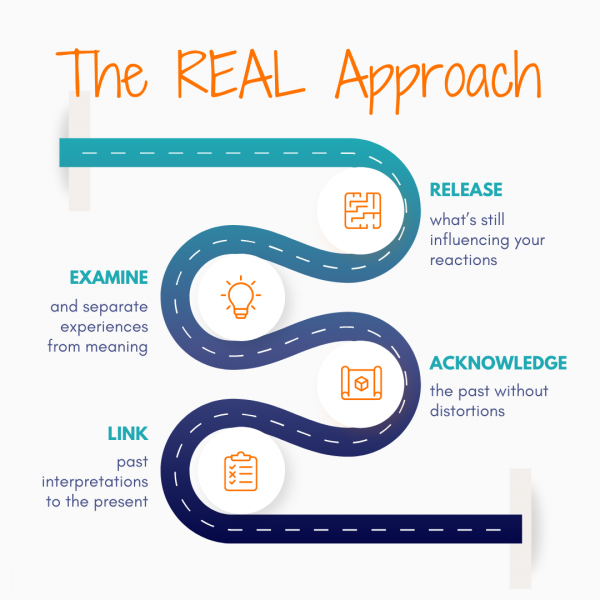
We move across four main areas. It’s not a fixed sequence, but a way of working that allows us to get to what actually matters. This is how it gets worked through:
Some of the focus is on RELEASE – addressing what’s carrying weight from past experiences and still influencing you.
We will also EXAMINE what’s shaped your life – going back through experiences in detail to separate what actually happened from the meaning attached at the time.
It’s also crucial to ACKNOWLEDGE – the past needs to be recognised as it is in order to move forward.
And then we LINK – seeing clearly how those past experiences, interpretations and responses connect to what’s happening now, so we can shape a different outcome.
Where you start depends on where you are
This is not something that changes overnight or through a single conversation. It takes time to work through properly, which is why I work in focused three-month blocks. That gives us the space to go into this in detail, to understand what’s actually happening for you and to start shifting it in a way that holds.
What matters is where you are within that process, not your situation on paper.
Relationship Reset
Whether you’re dating or already in a relationship, the same patterns tend to show up – in how you interpret behaviour, how you respond when something matters and how situations unfold over time.
Over three months, we go into this in detail. Not just what has happened in the past, but how you interpreted it at the time, what you made it mean and how that is still influencing how you respond now.
As that becomes clearer, the pattern starts to shift. You’re no longer reacting in the same way and the outcome begins to change as a result.
The focus is on what is actually happening for you and working through it in a way that goes beyond just talking about it.
Relationship Ready
Understanding Your Triggers in Relationships (And Why They Keep You Stuck)This builds on the work started in the first three months.
By this point, the patterns are clearer and the initial shifts have begun. The focus now is on what happens next – how that change holds when you’re actually in situations that matter.
Whether that’s continuing to date or being in a relationship, this is where responses are tested in real time. Not in controlled conditions, but in the moments where uncertainty, attachment or conflict come into play.
The focus here is on what happens when old interpretations are no longer accepted as fact. You begin to test what you would once have assumed and question the meaning you attach to someone’s behaviour. You change the way you respond to what would have previously triggered you.
Over time, that changes the way you experience dating and relationships. You’re not just understanding things differently; you see them and act differently – your internal reactions have evolved.
This is where things start to feel more settled because your approach has changed.
Relationship Roadmap
This is for those who want to stay in it long enough to see it through across different situations and not just in the early stages.
Relationships don’t stay static – and nor do you. Change is inevitable and that alone brings up different challenges. The attention shifts from understanding and applying, to working through real life and what happens as it unfolds.
It’s no longer about hindsight – it’s happening in real time, in real situations with real stakes.
It allows us to deal with the tougher times – because there will be some. So whether you encounter uncertainty, conflict or need to adjust to how a relationship develops over time, the value of the longer timeframe isn’t in doing more. It’s in not having to stop when things start to matter.
You don’t have to do anything with this
At this point, you will already have a sense of whether this is something you want to address or leave as is.
Nothing here requires you to act. You can take what you’ve read, think about it and decide to come back to it at another time.
But if you do want something to change, it has to be a conscious decision and you have to commit to approach it differently. That’s where it changes.